The Essential Role of Catering Icons in Modern Digital Design
In the bustling landscape of hospitality and event planning, catering represents a critical pillar of service and execution. It is the meticulous process of providing food, beverages, and related logistical support for events ranging from intimate corporate meetings to large-scale weddings and conferences. For designers and developers creating digital tools for this industry, visually representing this complex service is a key challenge. A well-crafted set of catering icons becomes a fundamental component in building intuitive interfaces that communicate function and process at a glance.
Streamlining Communication and Planning with Visual Assets
The integration of a dedicated catering icon set into a workflow begins long before an app or website is launched. During the initial design phase for a project management tool, event booking platform, or catering company website, designers need assets that accurately depict the specific actions and items associated with catering. This is where a line icon style, known for its clean, minimalist aesthetic, proves exceptionally valuable. Its simplicity ensures clarity across various screen sizes and resolutions, making it ideal for the practical implementation in mobile apps and responsive web templates.
Consider a project manager developing an event planning application. Early in the wireframing stage, they must decide how users will interact with features like menu selection, staff coordination, or equipment rental. Using generic icons can lead to user confusion, slowing down the workflow. By implementing specific catering icons—a line-style icon of a serving platter, a chef’s hat, or a delivery truck—the designer instantly establishes a clear visual language. This directly supports the user’s planning process, allowing them to navigate the app’s catering module efficiently and make decisions faster.
Practical Integration into Development and Design Workflows
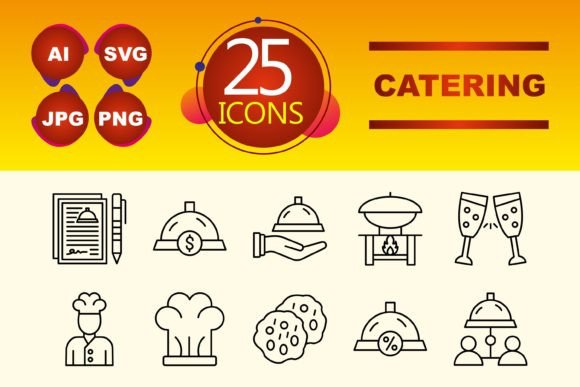
The technical specifications of an icon set, such as the inclusion of AI, JPG, PNG, and SVG file types, are not just details; they are crucial for compatibility and long-term use. A graphic designer working on a presentation for a catering startup might utilize the AI (Adobe Illustrator) files to customize colors to match the brand palette seamlessly. Meanwhile, a web developer will rely on the SVG files for their scalability and ability to be manipulated with CSS, ensuring the icons remain sharp and performant on any device. This multi-format approach eliminates a common workflow hurdle: asset conversion and quality loss.
For a freelancer creating an infographic about sustainable catering practices, the PNG files provide ready-to-use, high-quality assets that can be quickly placed into their layout software. This efficiency in asset organization means the creator can focus on the content and narrative of the infographic rather than struggling with icon creation. The consistent line style across all ten icons also guarantees visual harmony, a factor essential for professional quality control in any published material.
Enhancing User Experience Across Diverse Platforms
The application of catering icons extends beyond static websites. In a mobile app designed for on-the-event coordination, these icons play a dynamic role. An event supervisor using the app might tap an icon representing table setup to assign a task to a team member or use a beverage service icon to check the status of the bar inventory. The icon’s immediate recognizability reduces cognitive load, allowing the user to manage real-time logistics during the high-pressure execution phase of an event. This practical implementation directly impacts the efficiency and success of the catering service itself.
Usability is further enhanced when these icons are part of a larger, consistent design system. Educators creating online courses for hospitality management can incorporate them into slide decks (presentations) and instructional materials. The uniform line icon style maintains a professional tone, aiding in learning comprehension. Similarly, small business owners embedding a catering booking form on their site can use the icons as visual cues next to form fields (e.g., a cake icon next to “Dessert Selection”), improving form completion rates by making the interface more intuitive.
Strategic Considerations for Long-Term Asset Use
Adopting a dedicated icon set requires consideration for future scalability. A marketing agency building a template for catering company websites must think about how the icons will be used as the client’s business grows. The line icon style’s neutrality ensures it won’t clash with future branding updates. Furthermore, owning the source AI files allows for the creation of derivative icons if new services, like virtual event snack boxes, are added later. This foresight in preparation supports the asset’s longevity and avoids the need for a costly rework of the digital infrastructure.
Integration also involves how these assets interact with other tools. A blogger writing about wedding planning might use the icons within their content management system (CMS) to create visually appealing lists or comparison tables. The PNG and JPG formats provide easy drag-and-drop functionality into most CMS editors. This smooth integration into a content creation workflow helps the blogger produce more engaging, process-oriented guides for their readers without needing advanced design skills.
From Concept to Execution: A Cohesive Visual Narrative
Ultimately, a catering icon set serves as a bridge between the conceptual service of catering and its digital representation. It supports every stage of a project. Before an event planning software is coded, the icons guide the UX design. During the development phase, they are integrated as functional elements. After launch, they become the visual tools that end-users—the planners, caterers, and clients—employ to execute real-world events. Their value is measured not in hype, but in the silent efficiency they bring to complex workflows.
For the productivity-minded professional, whether a UI designer templating a new app or an entrepreneur crafting a service menu webpage, these icons remove a layer of abstraction. They translate the multifaceted operations of catering—logistics, menu curation, service, and presentation—into a clean, actionable visual language. By choosing a set with versatile file formats and a timeless line style, one ensures that this visual language remains clear, compatible, and effective, fostering better decisions, smoother processes, and more successful outcomes in the dynamic world of hospitality and event design.