The Night Club Icon Set: An Analysis for Designers
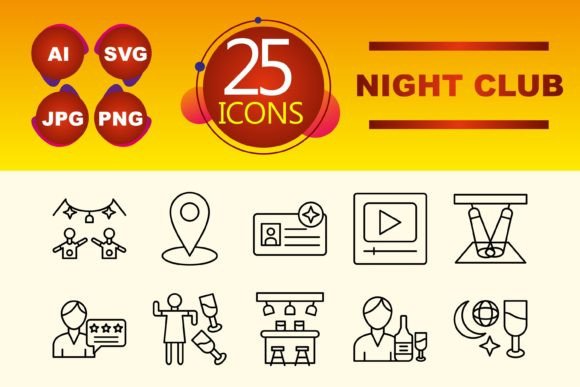
In the crowded landscape of digital iconography, specialized sets like the Night Club icon collection stand out by catering to niche themes. This set, comprised of 10 line-style icons, directly addresses the aesthetic and functional needs of projects centered around nightlife, entertainment, or a specific modern vibe. Unlike sprawling general icon libraries, the Night Club set offers a focused toolkit for designers working on mobile apps, website templates, presentations, infographics, or user interface designs that require this particular thematic coherence.
Understanding the Focused Nature of Night Club Icons
The Night Club set is distinct precisely because of its limited scope. With only 10 icons, it is not intended as a comprehensive solution for all interface needs. Instead, its value lies in its curated specificity. The line icon style—characterized by clean, outlined shapes without filled colors—contributes to a modern, minimalist aesthetic. This style is particularly effective in designs where simplicity and clarity are paramount, or where icons need to be easily overlaid on varied backgrounds without visual clutter.
The included file types—AI, JPG, PNG, and SVG—cover the essential spectrum of designer needs. SVG files are crucial for web and app development due to their scalability and editability, while AI files cater to vector editing in Adobe Illustrator, offering maximum flexibility for professionals. PNG and JPG formats provide ready-to-use raster images for contexts where vector support is limited. This multi-format approach ensures the Night Club icons can transition seamlessly from initial concept phases in a design tool to final implementation in a live application.
Comparative Context: Specialized Sets Versus General Libraries
When evaluating the Night Club icons, it is helpful to consider the broader category of icon resources. Most designers routinely access massive, general-purpose icon libraries containing thousands of symbols across every conceivable category. These are invaluable for projects with diverse needs. However, the tradeoff often involves a diluted thematic consistency; finding a cohesive subset of icons that all carry a specific style, like a unified nightlife feel, can be time-consuming within a vast library.
The Night Club set eliminates that search time. Its pre-curated collection ensures all 10 icons share a common visual language and theme. This can significantly speed up the design process for projects explicitly focused on clubs, events, parties, or contemporary urban experiences. However, this advantage is also its primary limitation. If your project scope expands beyond this narrow theme, you will very quickly need to supplement the Night Club icons with assets from another source. Therefore, its best-fit situation is either a project wholly dedicated to this theme or as a stylistic accent within a larger design that primarily uses other icons.
Evaluating the Line Icon Style
The choice of line style over filled, solid, or glyph styles is a significant decision factor. Line icons are often perceived as more elegant and less intrusive. They work well in interfaces with dense information, as they don’t compete heavily with surrounding text or graphics. Compared to solid icons, they can feel lighter and more contemporary. However, there are tradeoffs. In some user interface contexts, particularly where visual impairment or quick recognition is critical, solid icons might offer better contrast and faster comprehension. The Night Club set’s line icons would be most effective in designs targeting a sophisticated, mature audience where the aesthetic is part of the user experience, such as a nightclub event app or a high-end hospitality website template.
Another consideration is customization. Line icons, especially in SVG and AI formats, are typically easier to modify—adjusting stroke weight, color, or adding subtle effects—than more complex glyphs. This makes the Night Club set a flexible choice for designers who need to tweak the icons to match an existing brand palette precisely.
Practical Applications and Realistic Use Cases
Let’s explore scenarios where the Night Club icon set might be the right choice. Imagine you are designing a mobile app for ticket sales and event information for a specific nightclub. Core functions might include viewing event listings, buying tickets, seeing a line-up, and accessing a VIP menu. The 10 icons in the Night Club set could directly represent these concepts: a ticket stub, a musical note, a cocktail glass, a silhouette group for people, perhaps a time indicator for schedules. The consistent line style would create a clean, unified interface that reinforces the brand’s modern identity.
Similarly, in a website template for a event planner specializing in corporate parties or social galas, these icons could serve as visual anchors for service offerings. Used in an infographic about city nightlife economics, they would provide instantly recognizable symbols for key data points like venue capacity or beverage sales. Their scalability via SVG means they would remain crisp in both web graphics and printed presentation slides.
However, consider a different project: a comprehensive city guide app covering restaurants, museums, transportation, shopping, and nightlife. Here, the Night Club icons could beautifully represent the nightlife section, but you would need entirely different icon styles for museums, buses, or shops. Integrating the Night Club line icons with icons from another set or library could present a stylistic challenge. Achieving a harmonious look across the entire app might require extensive modification of either the Night Club icons or the supplementary icons, which adds to design time. In this case, opting for a single, broader icon library with a consistent style across all categories might be a more efficient path.
Decision Factors for Selecting the Night Club Set
Choosing the Night Club icon set depends on several key factors beyond just the theme. First, consider the scope of your project. Is the nightclub theme central or peripheral? Second, evaluate your need for stylistic coherence. If maintaining a specific minimalist, line-based aesthetic is critical, this set provides it instantly. Third, assess your format and editing requirements. The inclusion of AI and SVG files makes it a strong option for designers who need to edit at a granular level.
You must also weigh the cost of integration. While a small set like this is often affordable, the potential need to license or source additional icons for other parts of your project means your total icon investment might be higher than if you used a single, more expensive but all-encompassing library. Finally, think about future needs. If you are designing a template or product you plan to reuse or resell, having a limited icon set might constrain future iterations that require new features outside the nightlife theme.
When Another Option Might Be Necessary
The Night Club icons are an excellent resource, but they are not a universal solution. You likely need another option if your project requires more than a handful of themed icons. For instance, designing a full-featured hospitality management dashboard would need icons for finance, staff, cleaning, security, and reservations—far beyond what this set offers. Similarly, if your design language calls for a different visual style, such as detailed flat icons or playful 3D icons, the line style of the Night Club set would be a mismatch, even if the subject matter was relevant.
Furthermore, if your workflow heavily depends on a specific icon platform or plugin that allows dynamic searching and implementation of a vast library, switching to a standalone set like Night Club might disrupt your efficiency, despite its thematic perfection.
In essence, the Night Club icon set shines as a targeted, high-quality solution for specific design challenges. Its strengths are its curated theme, modern line style, and professional file format range. Its limitations are its narrow scope and the potential integration complexities with other icon sources. By carefully matching these characteristics to your project’s requirements, you can make an informed decision that balances aesthetic goals with practical implementation needs. For the designer whose current project lives firmly in the world of nightlife and contemporary entertainment, this set could be the precise, efficient tool that elevates the final design.