The Versatility of Medieval Icons
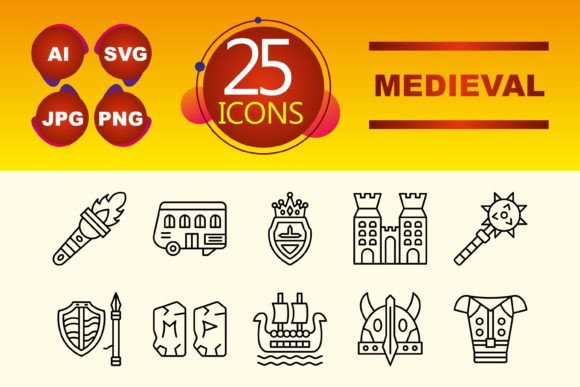
In digital design, specific visual themes can evoke particular atmospheres and histories with clarity and efficiency. Among these, a set of Medieval icons represents a curated collection of symbols drawn from the aesthetic and cultural motifs of the Middle Ages. Typically, such a set offers a focused library, often comprising ten distinct icons rendered in a clean Line Icon style. The included file formats—AI, JPG, PNG, and SVG—ensure these assets are ready for implementation across various digital projects, from mobile applications and website templates to presentations, infographics, and user interface designs.
Understanding the Appeal of Historical Iconography
Designers and content creators might gravitate towards a Medieval icon set for several objective reasons. Primarily, it provides immediate thematic cohesion. When a project requires conveying a sense of history, tradition, craftsmanship, or a fantasy aesthetic rooted in medieval lore, these icons offer a visual shorthand. The Line Icon style, characterized by clean outlines and minimal detail, contributes a modern, scalable simplicity that contrasts interestingly with the ancient subject matter, making the icons suitable for contemporary interfaces that need a touch of historical reference.
Furthermore, the practical value lies in the variety of file types. The inclusion of SVG and AI files supports vector scalability, allowing icons to be resized without quality loss for different screen resolutions and print materials. PNG and JPG files offer immediate raster compatibility for simpler integrations. This flexibility is a key consideration for teams working across multiple platforms and media.
Evaluating the Benefits and Tradeoffs
The benefits of using a specialized set like these Medieval icons are clear. They save considerable design time. Creating authentic, stylistically consistent historical icons from scratch requires research and artistic effort. A pre-made set delivers a ready-made visual vocabulary. The limited count of ten icons encourages focused use, preventing visual clutter and promoting a minimalist aesthetic that can enhance user comprehension in an interface.
However, there are inherent tradeoffs. The specificity of the theme is a double-edged sword. While perfect for aligned projects, the icons may be wholly unsuitable for contexts requiring a modern, futuristic, or entirely different historical vibe. The Line Icon style, while clean and versatile, may lack the texture or depth some designers desire for a truly rich medieval atmosphere. In such cases, a set with filled or detailed icon styles might be a better fit, though often at the cost of scalability and simplicity.
Key Considerations Before Adoption
When evaluating whether this Medieval icon set aligns with your needs, several practical considerations should guide your decision. First, assess the scope of your project. Do you require a broad icon library covering diverse functions, or is a narrow, thematic set sufficient? If your project only needs occasional historical visual cues alongside a broader icon library, this set might serve as a supplemental resource rather than a primary one.
Second, examine the technical requirements. The provided file formats must match your workflow. SVG support is crucial for web development and responsive design. AI files are valuable for further customization in Adobe Illustrator. If your work primarily uses software incompatible with these formats, the utility of the set diminishes.
Third, consider stylistic integration. The Line Icon style should complement your existing design language. Evaluate if the line weights, corner styles, and overall simplicity of the Medieval icons harmonize with other visual elements in your project. Consistency in style is vital for professional design outcomes.
Situations Where Medieval Icons Are a Strong Fit
This icon set is particularly advantageous in defined scenarios. Educational websites or apps focusing on medieval history can use these icons as intuitive navigation elements or decorative enhancements. Game interfaces for fantasy or historical titles benefit from immediately recognizable thematic symbols. Template designers creating themes for blogs, presentations, or portfolios centered around history, literature, or traditional crafts will find these icons provide quick, authentic styling. In these contexts, the icons act as both functional elements and atmospheric enhancers, fulfilling a dual purpose efficiently.
When to Explore Alternative Solutions
Despite its strengths, a focused Medieval set may not be the optimal choice in other situations. If your project requires a comprehensive icon library for a complex application with hundreds of diverse actions and objects, a general-purpose UI icon pack with thousands of icons is a more practical base. You could then supplement it with thematic packs like this Medieval set for specific sections.
Additionally, if your design vision for a medieval theme calls for more ornate, colored, or textured illustrations, a line art set might feel insufficient. Exploring alternative resources that offer filled icons, detailed glyphs, or even custom illustration services would be worthwhile. The decision hinges on the required level of visual density and the balance between thematic authenticity and modern UI clarity.
Practical Insights for Decision Making
Ultimately, selecting design resources like a Medieval icon set should be driven by a clear match between the asset's offerings and the project's concrete goals. Begin by listing the specific visual needs: the themes you must convey, the number of icons required, and the technical formats your team uses. Compare this list against the set's description—ten Medieval icons in Line style, with key vector and raster formats.
Objectively weigh the value of time saved versus the potential limitations of scope and style. For a small-scale, theme-specific project, the set likely offers high value. For a large-scale, multi-themed project, it may be a niche add-on. Remember, the most effective use of thematic icons often comes from restrained, intentional application, using them to accent key areas rather than overwhelm an entire design. By approaching the evaluation with these practical criteria, you can determine whether this collection of Medieval icons aligns with your functional needs and creative direction, ensuring your design resources are both effective and appropriate.