Understanding Soccer Icon Sets: A Visual Toolkit for Modern Design
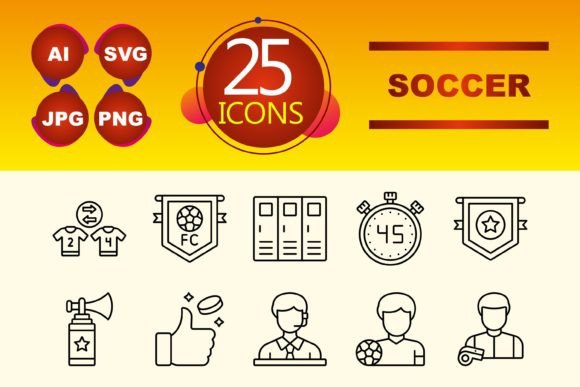
In the digital world, clear and immediate communication is paramount. Whether you’re guiding a user through a mobile app, building a website for a local club, or creating a presentation on sports analytics, you need visuals that convey ideas instantly. This is where specialized icon sets come into play. For the vast global community engaged with soccer—from fans to developers to business professionals—a dedicated set of soccer icons is not just decorative; it’s a fundamental functional asset. This article explores the purpose, significance, and practical application of a soccer icon set, such as one featuring ten essential line-style icons available in versatile file formats like AI, JPG, PNG, and SVG.
The Foundation: What Are Soccer Icon Sets?
An icon set is a curated collection of simplified graphical symbols representing specific concepts, actions, or objects. A soccer icon set focuses specifically on elements central to the sport. Think of a soccer ball, a goal, a player, a whistle, or a trophy. When rendered in a consistent style—like the popular Line Icon style mentioned—these icons create a cohesive visual language. Line icons are characterized by clean, single-weight outlines and often minimal detail, making them elegant, modern, and highly legible even at small sizes.
Their primary purpose is to enhance usability and comprehension. An icon of a soccer boot can signify a “equipment” section faster than text alone. This speeds up navigation, reduces cognitive load for the user, and creates a more engaging interface. They serve as visual shorthand, bridging language barriers and making digital experiences more intuitive for a global audience passionate about soccer.
The Significance of Style and Format Variety
The specification of “Line Icons” and the inclusion of multiple file types (AI, JPG, PNG, SVG) are not incidental details; they are critical to the set’s utility. The line style offers a timeless, uncluttered look that integrates seamlessly into diverse design projects without dominating the layout. It’s professional enough for a corporate sports marketing website and sleek enough for a cutting-edge mobile app.
The file format variety is what truly unlocks this set’s potential across different domains:
- AI (Adobe Illustrator): This is the source vector file. Designers and creatives use it to edit, scale, or customize the icons without any loss of quality, tailoring them to specific brand colors or project needs.
- SVG (Scalable Vector Graphics): This web-friendly vector format allows icons to scale infinitely on websites and apps, remaining crisp on any screen size or resolution. It’s essential for responsive design.
- PNG (Portable Network Graphics): A raster format with transparency support. PNGs are perfect for fixed-size use in presentations, digital documents, or where complex vector support isn’t available.
- JPG (JPEG): A standard raster format useful for quick placements in draft layouts or in environments where only basic image formats are accepted.
This multi-format approach ensures the icons are not locked into one use case. They become a flexible toolkit, ready for anything from a high-fidelity UI design template to a simple infographic in a school project.
The Practical Relevance: Where Soccer Icons Come to Life
The application of these icons stretches far beyond mere decoration. They fit naturally into modern digital life, work, and creativity.
In Technology and User Experience (UI/UX)
For developers and UI/UX designers building soccer-related applications, these icons are interface staples. A ten-icon set covering basics like a ball, field, referee, and scoreboard can define key app sections: “Live Games,” “Rules,” “My Team,” “Store.” Their consistent line style ensures a professional, unified look across all screens. Using SVG files means the icons look perfect on every user’s smartphone, tablet, or desktop, a core tenet of good user experience.
In Business and Communication
Businesses in the sports sector—ticketing platforms, merchandise stores, coaching services—use such icons to clarify their offerings quickly. An icon set can elevate a website template, making it more visually appealing and easier to navigate. In presentations for sponsors or stakeholders, icons in PNG format can visually break down complex data on player statistics or fan engagement, making the information more digestible and memorable.
In Education and Information
Teachers and educators creating materials about sports history, health, or teamwork can use these icons to create engaging infographics. A simple diagram using a player icon, a ball icon, and a goal icon can explain a tactical formation more clearly than paragraphs of text. This visual approach aids learning for beginners and younger audiences, demystifying the sport’s structure.
In Daily Activities and Community
Even for casual use, these icons have a place. A community league might use them in a simple JPG flyer to advertise tryouts. A blogger could embed SVG icons directly into a post to highlight key points about a match recap. They serve as universal symbols that resonate in daily discussions and community organizing around soccer.
Clarifying Common Assumptions
A frequent misunderstanding is that such icon sets are only for professional graphic designers. While designers benefit deeply from the editable AI files, the provided PNG and JPG formats make them accessible to anyone. A coach with basic word processing software can still drag and drop a PNG icon of a whistle into a training schedule. Another assumption is that more icons are always better. A focused, high-quality set of ten core icons is often more valuable than a sprawling, inconsistent collection. It forces thoughtful selection and promotes a cleaner, more purposeful design.
Building a Broader Understanding: Icons as Part of Visual Culture
Ultimately, a specialized soccer icon set is more than a digital asset pack. It’s a reflection of how visual communication has evolved in our interconnected world. Soccer, as a global phenomenon, needs a visual language that travels across cultures and platforms. These line icons become part of that language—instantly recognizable symbols that connect functionality with passion.
By understanding the thought behind their style (clean lines for versatility) and their technical delivery (multiple formats for broad application), users from all backgrounds—beginners grabbing a PNG for a flyer or experienced developers implementing SVG in a complex app—can leverage them effectively. They bridge the gap between the love for the sport and the practical needs of sharing information, building tools, and creating experiences around it. In doing so, they underscore that in today’s digital landscape, good design is not just about looking attractive; it’s about enabling clear communication, seamless interaction, and broader connection within the world’s most popular sport.