Water Sports Icons: A Practical Resource for Digital Projects
When building a digital interface—whether it's a mobile app, a website, or a presentation—visual clarity and thematic consistency are paramount. For projects centered around aquatic activities, finding a cohesive set of graphical elements can be a foundational step. A set of Water Sports icons, specifically designed in a line style, presents itself as a potential solution for designers and developers. This article explores the nature and utility of such icon sets, examines their distinct characteristics, and provides a balanced view on how they fit within the broader landscape of design resources.
The Distinct Nature of Line Icon Sets for Water Sports
Water Sports, as a thematic category, encompasses a wide range of activities from sailing and kayaking to surfing and diving. An icon set dedicated to this theme aims to distill these often complex and dynamic activities into simple, recognizable symbols. The "line" style is a particularly popular approach. It refers to icons created using clean, single-weight strokes, resulting in outlines of the subjects without filled colors or intricate shading. This minimalist aesthetic offers several inherent strengths. It aligns well with modern, clean interface design trends, ensures icons remain legible at small sizes, and typically integrates seamlessly with varied color schemes and backgrounds.
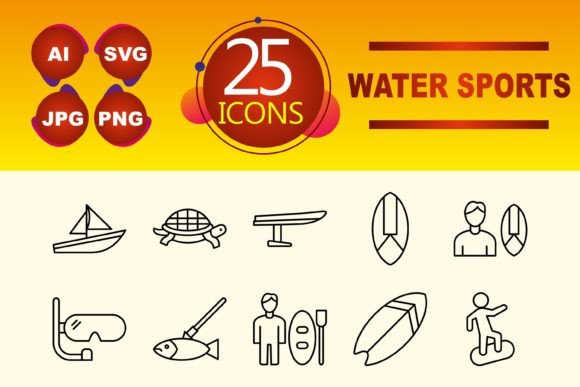
What makes a dedicated Water Sports icon set distinct from generic or self-made icons is its thematic completeness and stylistic uniformity. Instead of sourcing a surfing icon from one library and a boat icon from another—each with potentially different visual languages—a curated set provides consistency. The ten icons mentioned, covering key activities, mean a designer can represent the full scope of the subject matter without stylistic mismatch. The included file formats—AI, JPG, PNG, and SVG—are a crucial aspect of its utility. SVG files, for instance, are vector-based, allowing for infinite scaling without loss of quality, which is essential for responsive web design. AI files cater to Adobe Illustrator users seeking to customize the assets, while PNG and JPG offer immediate raster usability.
Comparing Approaches to Acquiring Visual Assets
Designers facing the need for Water Sports visuals generally have a few alternative paths. One is to commission custom illustrations, which offers unlimited creativity and perfect alignment with a specific brand identity. However, this approach is typically time-consuming and costly, making it less practical for smaller projects or rapid prototyping. Another common alternative is to use large, general-purpose icon libraries or marketplaces. These repositories offer thousands of icons across all categories, often under subscription models. While this provides immense variety, the tradeoff can be a lack of depth in niche themes like Water Sports; you might find only a few relevant icons, and they may not share a cohesive line style with each other.
The third path, which a focused Water Sports set represents, is the purchase or download of a niche, topic-specific pack. This approach sits between the two extremes. It offers more thematic depth than a general library scan for this particular topic, and it is far more efficient and affordable than custom work. The decision factor here often hinges on project scope. For a comprehensive website for a marina or a water sports event app, a dedicated ten-icon set might cover most needs efficiently. For a single blog post needing one surfing icon, a large general library or even a free search might suffice. The strength of the niche set is its curated focus; its limitation is its finite scope—if your project requires an icon for a very obscure water sport not included, you'll need to supplement it from another source.
Evaluating File Format Inclusion and Style Commitments
The provision of multiple file types (AI, JPG, PNG, SVG) is a significant practical benefit. It speaks to the set's intended use across different tools and stages of the design process. Comparing this to some alternatives highlights its utility. Some free icon resources offer only PNG in one size, which can become problematic when you need to scale the asset up or modify its color. SVG support is particularly valuable for modern web and app development, as it allows developers to control the icon with CSS, changing its color or adding animations dynamically. The inclusion of AI (Adobe Illustrator) files is a strong indicator that the set is intended for professional designers who might need to adjust stroke weights, combine elements, or integrate the icons into larger vector compositions.
Committing to the line icon style also involves a tradeoff. The line approach is versatile and clean, but it may not suit every project's visual tone. A children's educational app about water safety might benefit from more colorful, filled, and cartoonish icons. A luxury yacht charter website might seek more detailed, photorealistic, or gold-accented symbols. Therefore, while a Water Sports line icon set is an excellent fit for minimalist, corporate, or tech-focused interfaces, it may not be the right choice for projects requiring a different emotional resonance. Recognizing the style's best-fit situations is key: administrative dashboards for sports federations, instructional apps for learning sports, booking platforms for aquatic adventures, and informational infographics are all strong candidates.
When a Water Sports Icon Set Is the Right Choice
Choosing this type of resource makes sense under several realistic conditions. Firstly, when time and budget constraints exist, but a professional, consistent look is required. The set provides a quick-start solution. Secondly, when the project's content is squarely focused on multiple water-based activities, and you need to visually represent those activities repeatedly across pages or screens. The consistency reinforces brand and user understanding. Thirdly, when the technical requirements of the project demand scalable, adaptable vector graphics (SVG) for a responsive website or high-resolution app. The multi-format offering directly supports this need.
Consider a practical example: a developer is creating a mobile app for a coastal tourism board. The app features sections on surfing lessons, jet ski rentals, snorkeling tours, and sailing trips. Using a cohesive Water Sports icon set for each section's tab icon and header graphic instantly creates a unified experience. The SVG files allow the icons to adapt perfectly to different screen densities and orientations. Alternatively, a web designer building a template for water sports clubs can use these icons as default visuals within the template, offering clients a ready-made, professional graphic suite.
Recognizing When Another Option May Be Needed
Despite its advantages, there are clear scenarios where a dedicated Water Sports set might not be the optimal resource. If your design project requires a vast icon library beyond water themes—you also need icons for weather, user profiles, settings, and payment methods—then a broader subscription-based icon platform might be more economical and efficient in the long run. Similarly, if the specific line style clashes with an established and intricate brand identity that uses filled icons with gradients and shadows, forcing these line icons into the system could harm visual cohesion.
Another consideration is the scope of the set itself. Ten icons cover many core activities, but they might not encompass every possible need. For instance, if your project focuses exclusively on competitive underwater hockey, a niche set might not include that specific icon. In such cases, the better path might be to use a general library's search function or consider minimal custom illustration for that one key asset. The decision factor here is the percentage of your icon needs that the set satisfies. If it covers 80% of your needs, it can be a great base to be supplemented. If it covers only 20%, it's likely not a cost-effective starting point.
Making an Informed Decision on Visual Resources
The choice between a thematic Water Sports icon pack, a general icon library, or custom illustration is not a matter of one being universally superior. It is a practical decision based on project parameters. Key factors to weigh include: the breadth of your icon needs both within and outside the water sports theme; the required visual style and its alignment with your brand; the technical needs for file formats and scalability; and, of course, the constraints of timeline and budget.
A Water Sports line icon set excels as a targeted, efficient, and professional solution for digital projects deeply connected to aquatic activities. Its value is concentrated in its thematic consistency and practical file format offering. By understanding its distinct position compared to the wider alternatives—the tradeoffs in style versatility, the limitations in scope, and the strengths in cohesion—you can assess whether it aligns with your specific project's goals. Ultimately, the most informed decision comes from mapping the features of the resource against the concrete requirements of your interface, template, or presentation, ensuring the visual assets you choose enhance clarity and user experience without unnecessary compromise or overhead.