Chemistry Symbols as a Digital Design Element
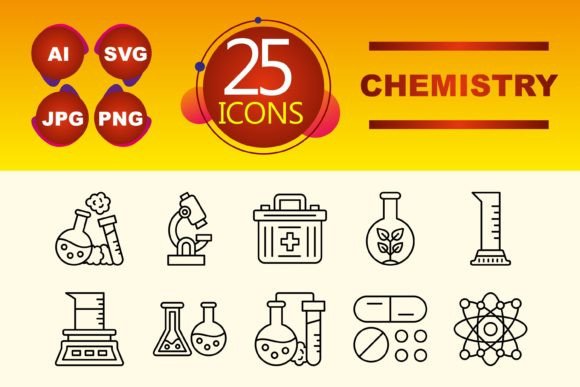
The discipline of chemistry provides a universal visual language. Its symbols—the flask, the atom, the molecule, the test tube—are immediately recognizable, conveying concepts of science, experimentation, precision, and innovation. For creators working in digital mediums, a well-crafted set of chemistry icons can be an invaluable asset. This particular set, described as offering 10 line icons in AI, JPG, PNG, and SVG formats, presents a focused toolkit for integrating this visual language into projects.
Core Characteristics and Practical Value
The stated specifications of this chemistry icon set define its scope and potential utility. The limitation to 10 icons suggests a curated, rather than exhaustive, collection. This can be a strength for projects requiring a consistent, cohesive aesthetic without overwhelming choice. The included file types cover the essential needs of most digital workflows. The AI (Adobe Illustrator) file is crucial for designers who require editable vector source art for customization. The SVG format is indispensable for modern web development and app interfaces, offering scalable, resolution-independent graphics with potential for animation or interactivity. The PNG and JPG raster formats provide immediate, easy-to-use assets for presentations, quick mockups, or environments where vector support is limited.
The line icon style is a significant design choice. Line icons, characterized by clean strokes and often minimal filled areas, tend toward a modern, lightweight aesthetic. They are typically effective at small sizes and integrate well with contemporary UI designs, infographics, and presentation slides where clarity and simplicity are prioritized over decorative detail.
Evaluating Usability and Integration
From a practical standpoint, the value of any icon set lies in its seamless integration into a creator's workflow. The multi-format delivery addresses a key pain point: avoiding the need to convert files manually, which saves time and preserves quality. A designer can open the AI file to tweak a bond angle on a molecule icon to match a brand color, while a developer can directly embed the SVG version into a React component for an educational app.
Consistency across the 10 icons is vital. For a user interface or a sequenced infographic, the icons should share a common stroke weight, level of detail, and visual scale. A disjointed set, where one icon is overly complex and another is overly simplistic, would undermine professional presentation. Assuming this chemistry set maintains that internal consistency, it becomes a reliable module—a plug-and-play visual package that maintains a uniform tone.
Audience Fit and Application Scenarios
The potential beneficiaries of this resource are directly tied to its specifications. Educators and academic publishers can use these icons to create engaging slides for lectures, interactive e-learning modules, or illustrative diagrams in digital textbooks. The line style is often clear enough for explanatory purposes. App developers and UX designers focusing on science education, laboratory simulation, or even pharmaceutical or chemical industry software might find these icons fundamental for navigation elements, feature symbols, or status indicators.
Marketing professionals and content creators in tech, health, or research sectors can leverage the universal symbolism of chemistry. An icon of a beaker or an atom in a blog post graphic, social media card, or presentation instantly signals themes of innovation, testing, or scientific rigor. For small business owners in niche fields—such as selling laboratory equipment or science kits—these icons could enhance website aesthetics and product presentations with relevant, non-generic imagery.
Strengths and Possible Limitations
A primary strength of such a focused set is its immediate applicability. Unlike browsing a massive icon library with thousands of options, a user with a chemistry-related project can quickly deploy these without extensive filtering. The vector source (AI) ensures long-term value, as icons can be adapted for future projects—colors can be changed, elements can be combined, or styles can be slightly modified to stay aligned with evolving brand guidelines.
Potential limitations naturally stem from its focused scope. A project requiring a highly specific or obscure chemical apparatus not covered among the 10 icons would need supplemental assets. The line style, while clean and modern, may not suit projects demanding a more classic, filled, or three-dimensional illustrative feel. Furthermore, the aesthetic quality hinges entirely on the execution of the line work itself: the precision of the curves, the balance of negative space, and the intelligibility of each symbol at small sizes. A poorly drawn line icon set would fail in its core purpose.
Professional Observations on Implementation
In real-world use, the effectiveness of these chemistry icons would be tested in scenarios like responsive web design. An SVG atom diagram must remain crisp and identifiable when viewed on a high-resolution desktop monitor and when scaled down to a mobile phone screen. In a presentation template, the PNG versions should not appear pixelated or fuzzy when projected on a large screen.
A recommended practice for users would be to test the icons in their intended environment early in the project. Place the SVG in a prototype interface and check for clarity alongside text. Use the PNG in a slide deck draft to assess visual weight against other slide elements. This practical step validates the set's fit before full commitment.
Final Considerations for Your Project
Deciding whether this chemistry icon set aligns with your needs requires matching its profile to your project parameters. If your work demands a cohesive, minimalistic visual representation of chemical concepts across digital formats, and the ten symbols offered (presumably covering basics like flasks, burners, atoms, and molecules) align with your content, then this set represents a efficient solution. It removes the task of sourcing or creating disparate icons individually.
Conversely, if your project is deeply specialized, requiring icons for niche laboratory equipment or complex organic chemistry structures, this general set would serve only as a foundational starting point. Similarly, if your brand or design system employs a heavily filled, cartoonish, or retro aesthetic, the line style might require significant modification to blend in.
Ultimately, a well-executed line icon set for chemistry functions as more than just decoration. It is a functional, semantic tool that bridges the abstract world of science and the concrete needs of digital communication. By providing the core symbols in the core formats, it empowers a wide range of professionals to incorporate this visual language efficiently, enhancing clarity and thematic resonance in their mobile apps, website templates, presentations, and design projects.