The Essential Guide to Personal Transportation and Its Visual Representation in Design
Personal transportation is a fundamental aspect of modern life, encompassing the vehicles and modes we use to move ourselves from one point to another. It's the car you drive to work, the bicycle you ride for exercise, the scooter you use for a quick errand, and even the walking paths you take through your neighborhood. This concept is deeply woven into our daily routines, urban planning, and environmental considerations. In the digital age, representing these concepts clearly and efficiently is crucial for communication. This is where specialized icon sets, like a collection of Personal Transportation icons, become invaluable tools for designers and developers across various projects.
Understanding Personal Transportation: From Concept to Reality
At its core, personal transportation refers to any mode of transport used primarily for individual or small-group travel, rather than mass public transit. Its purpose is to provide autonomy, flexibility, and convenience in movement. The significance of personal transportation extends far beyond simple mobility; it influences city layouts, economic productivity, personal freedom, and even social interactions. The evolution from horse-drawn carriages to electric vehicles illustrates its constant adaptation to technology and societal needs.
In contemporary life, personal transportation fits into almost every domain. For work, it enables commuting and business travel. In daily activities, it's how we access groceries, healthcare, and leisure. Its practical relevance touches on time management, cost of living, and lifestyle choices. For instance, choosing a bicycle over a car for short trips can impact personal health, fuel expenses, and traffic congestion. A common misunderstanding is that personal transportation solely means private cars. In reality, it includes a wide spectrum: motorcycles, e-bikes, pedal bicycles, skateboards, and personal mobility devices like electric scooters, all playing vital roles in a diversified transportation ecosystem.
The Role of Icons in Communicating Transportation Concepts
When we move from the physical world to digital interfaces, representing these transportation modes requires clear, universal symbols. Icons serve as visual shorthand, conveying complex ideas instantly without lengthy text. In mobile apps for ride-sharing, website templates for automotive services, or presentations on urban innovation, well-designed icons improve user experience, navigation, and comprehension. They are the visual cues that help users find the "bike rental" option or identify the "car parking" section effortlessly.
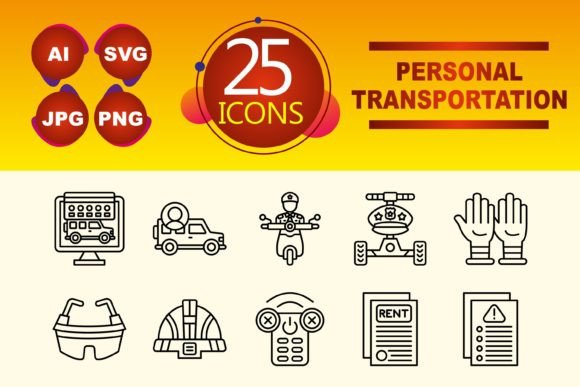
A set of Personal Transportation icons, such as one featuring 10 distinct line-style icons, provides a cohesive visual language. The line icon style, characterized by clean, outlined shapes without filled colors, offers a modern, minimalist look. This style excels in digital environments due to its scalability and clarity on both high-resolution and small mobile screens. It aligns with contemporary design trends favoring simplicity and efficiency.
The Practical Application of a Personal Transportation Icon Set
Let's explore how such an icon set fits into specific projects. Consider a city planning department creating an infographic about sustainable commute options. Using recognizable line icons for a car, bus, bicycle, and pedestrian allows the audience to quickly compare statistics. In a mobile app for a multi-modal transport service, icons for different vehicle types (scooter, car, bike) enable users to select their preferred ride with a simple tap. For a user interface design template for a logistics website, icons representing delivery trucks (a subset of personal transport for commercial individuals) can streamline the dashboard layout.
The included file formats—AI, JPG, PNG, and SVG—are critical for this versatility. The AI file allows for unlimited editing in Adobe Illustrator for designers who need customization. JPG and PNG are standard raster formats suitable for web graphics and presentations where vector editing isn't required. The SVG format is perhaps the most important for modern web and app development; as a vector file, it scales to any size without losing quality, ensuring icons look sharp on any device, which is essential for responsive design.
Examples help solidify this understanding. A web designer building a site for an electric vehicle (EV) dealership might use the car icon from the set in the navigation menu, the charging station icon on a service page, and a location pin icon integrated with a vehicle icon on a map. This creates a consistent, intuitive experience. The icons work naturally, not as decorative elements, but as functional guides that enhance the site's usability and support its informational content.
Building a Broader Understanding: Icons as Part of a Design System
To truly grasp the value, one must see these icons not as isolated graphics but as components of a larger design system. In technology and business, consistent visual communication builds trust and brand recognition. A set of 10 cohesive line icons ensures that every representation of transportation across an organization's materials—from its app to its internal presentations—is unified. This prevents confusion and creates a professional, polished appearance.
For creativity and education, such icon sets are foundational tools. A student learning about UI/UX design can use them to practice creating intuitive layouts. An educator can incorporate them into teaching materials about urban mobility. They serve as building blocks, enabling creators to focus on structure and content rather than drawing each symbol from scratch. This efficiency is vital in fast-paced digital environments.
Why Line Icons and Personal Transportation Are a Perfect Match
The choice of line style for personal transportation icons is particularly apt. Transportation vehicles are often mechanically complex, but their universal silhouettes are simple and recognizable. A line drawing of a bicycle, focusing on its frame and wheels, captures its essence without unnecessary detail. This aligns with the principle that icons should be comprehensible at small sizes. The clean lines also convey a sense of modernity and precision, reflecting the technological advancement in transportation itself—from streamlined car designs to sleek electric scooters.
Furthermore, in the context of SEO and helpful content, using clear icons on a website or app contributes to a positive user experience, which is a core ranking factor. When users easily find information about transportation services aided by intuitive icons, they are more likely to stay engaged. The semantic meaning these icons carry—each representing a real-world object—supports the page's topic and reinforces the content's relevance for informational searches like "personal transportation options" or "urban commuting icons."
In conclusion, personal transportation is a dynamic and essential field, and its digital representation through iconography is equally important. A dedicated set of Personal Transportation Line Icons, offered in multiple practical file formats, is more than just a collection of images. It is a toolkit for effective communication in app development, web design, educational material, and business presentation. It helps bridge the gap between the physical act of moving and the digital need to explain, offer, or organize that movement. By understanding both the real-world context and the design utility, creators can employ these icons to build interfaces and content that are not only visually appealing but also genuinely helpful and intuitive for all users.