The Role of Line Icon Sets in Enhancing Fashion Ecommerce Experiences
In the visually driven world of fashion ecommerce, every element of a digital interface communicates style, functionality, and brand identity. The choice of visual assets, from photographs to icons, plays a critical role in guiding user interaction and facilitating sales. Among these assets, specialized icon sets have emerged as foundational tools for designers and developers. A focused collection, such as a set covering fashion ecommerce relative icons, provides a cohesive visual language for platforms where shopping, browsing, and product discovery are central activities.
Deciphering the Fashion Ecommerce Relative Icon Set
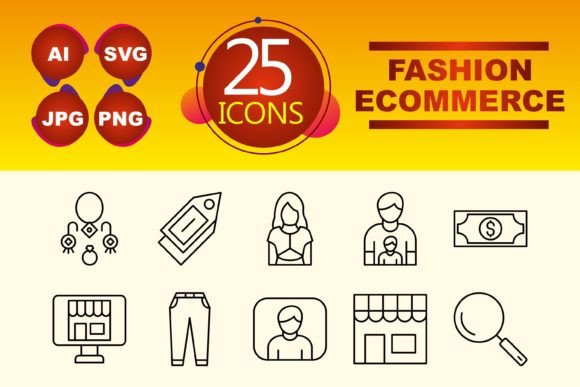
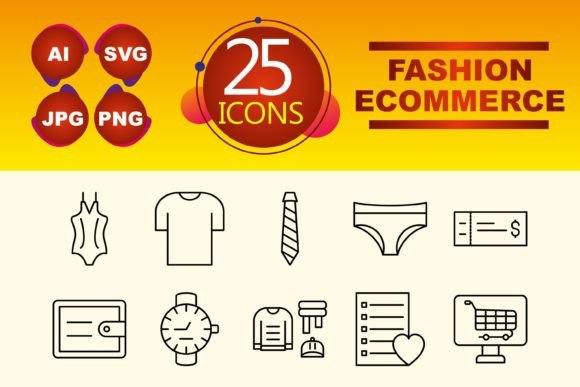
When we discuss a set that is ecommerce relative, we refer to its thematic alignment with online retail activities and concepts. A fashion-specific version narrows this focus to the particular actions, items, and symbols pertinent to clothing, accessories, and apparel shopping. The described set, with its ten individual icons rendered in a line style, offers a minimalist yet expressive toolkit. Line icons are characterized by their clean, outlined forms without fill, which lends them a modern and lightweight aesthetic. This style is particularly effective in digital environments where clarity and speed of recognition are paramount.
The inclusion of multiple file types—AI, JPG, PNG, and SVG—is a significant feature that speaks to practical application. The AI file allows for infinite customization within vector editing software, perfect for brands wanting to adjust stroke weight or integrate specific color palettes. The JPG and PNG formats provide ready-to-use raster images for simpler implementations. Crucially, the SVG format is the cornerstone for contemporary web and app development. As a scalable vector graphic, it ensures icons remain sharp and crisp at any resolution or screen size, a non-negotiable requirement for responsive design in ecommerce.
Core Applications Across Digital Platforms
The utility of such a focused icon set extends far beyond a single use case. Its primary value lies in its adaptability across the entire spectrum of digital touchpoints in the fashion retail journey.
In mobile applications, where screen real estate is limited, these icons become essential navigational aids. A simple line icon for a shopping bag, a heart for favorites, or a tag for price information can convey function instantly, replacing lengthy text labels. This contributes to a cleaner interface and faster user comprehension, directly impacting the ease of the shopping process.
For website templates, especially those built for fashion brands or multi-vendor marketplaces, incorporating a consistent set of ecommerce relative icons establishes visual uniformity. They can be used in filtering options (e.g., icons for dress, shoe, or hat categories), in the user account dashboard to represent order history or saved addresses, and in promotional banners to highlight features like free delivery or secure payment.
In presentations and infographics, these icons serve as visual shorthand. When explaining market trends, consumer behavior, or the operational flow of an online fashion store, well-recognized icons for a cart, a refund, or a delivery truck can make complex information more digestible and engaging for stakeholders, educators, or students.
Perhaps one of the most impactful uses is within user interface design templates for prototyping tools. Designers crafting new ecommerce experiences can rapidly populate their wireframes and mockups with these fashion-relative icons to test layout and user flow. This accelerates the design phase and ensures iconography is considered from the earliest stages of platform development.
Advantages of a Cohesive and Minimalist Icon Approach
Employing a dedicated set, rather than sourcing individual icons from disparate libraries, offers several tangible benefits. First is consistency. All ten icons share a common line weight, stylistic treatment, and visual proportion. This creates a harmonious look across the interface, which reinforces brand professionalism and attention to detail. Inconsistent icon styles can make a digital platform feel fragmented and less trustworthy.
Secondly, the minimalist nature of line icons aids in usability. Their reduced visual complexity allows them to stand out clearly against busy backgrounds like product photography without competing for attention. They function as supportive elements, guiding the user rather than dominating the scene. This aligns with modern UI principles that prioritize content—in this case, the fashion products themselves.
From a technical performance perspective, especially for SVG versions, these icons are typically lightweight in file size. Using them contributes to faster page load times and smoother app performance. For fashion ecommerce, where speed can directly influence conversion rates and user satisfaction, this is a practical advantage not to be overlooked. Furthermore, SVG icons can be easily animated or interacted with—for example, a cart icon that subtly expands when an item is added—adding a layer of dynamic feedback to the user experience.
Considerations for Selection and Implementation
While a ten-icon line set provides a strong foundation, its implementation requires thoughtful planning. One must audit the specific needs of the platform. Does the set cover all critical actions? Common fashion ecommerce icons might include representations for categories like men, women, kids; for functions like search, filter, compare; and for transactional elements like payment, shipping, and support. A ten-icon set is curated, not exhaustive, so it may need to be supplemented for highly complex platforms.
The line style itself is a choice. It conveys modernity and simplicity, but may not suit brands with a vintage, ornate, or highly luxurious aesthetic. In such cases, the provided AI files become invaluable, as designers can adapt the base line forms to match a different style guide, perhaps adding subtle textures or converting them into filled icons for a bolder presence.
Another key consideration is semantic meaning and cultural recognition. An icon must be intuitively understood by a global audience. A line icon for a "return" might be symbolized by a box with an arrow, which is widely recognized. Testing icon comprehension with diverse user groups is a recommended step to ensure the visual language is effective and does not introduce confusion into the shopping workflow.
Ultimately, integrating such a set is not just a design task but a strategic one. The icons become part of the brand's digital vocabulary. Their consistent use across the website, the mobile app, and even in email marketing creates a seamless and recognizable experience for the customer, from discovery to post-purchase support. This coherence builds confidence and can enhance the perceived reliability of the fashion ecommerce operation.
The Broader Context: Icons as Ecommerce Infrastructure
Viewing icon sets as mere decorative elements underestimates their function. In sophisticated ecommerce ecosystems, they are integral components of the user interface infrastructure. They are the signs and symbols on the digital highway that lead the consumer to their goal. A well-designed, thematically appropriate set reduces cognitive load. A customer looking to filter a shoe search does not need to read "Filter by Size"; a simple icon of a shoe with a ruler next to it can communicate the action more quickly and universally.
For the professionals building these platforms—the UI/UX designers, front-end developers, and product managers—having access to a ready-made, multi-format set like this accelerates production. It solves a common problem efficiently, allowing teams to focus on larger challenges like personalization algorithms, payment security, or inventory integration. The set acts as a reliable, off-the-shelf component that meets a baseline need for visual communication.
Moreover, the trend towards visual search and gesture-based navigation in mobile commerce further underscores the importance of clear, scalable icons. As interfaces evolve beyond traditional menus, icons will likely play an even more central role as touchpoints for interaction. Their design quality and consistency will directly affect the fluency of these new modes of shopping.
In conclusion, a specialized fashion ecommerce relative icon set in line style is more than a collection of graphics. It is a practical toolkit that addresses the unique visual communication requirements of selling fashion online. Its value is proven through its versatility across applications, its contribution to interface consistency and performance, and its role in creating intuitive, user-friendly shopping environments. By understanding its characteristics and thoughtfully implementing it, designers and businesses can enhance the digital experience, making the journey from browsing to buying not only functional but also visually coherent and efficient.