Visual Assets for Gaming Ecommerce Ventures
The digital marketplace for gaming has exploded beyond mere digital downloads of games. Gaming Ecommerce encompasses any online transaction involving gaming-related products and services. This includes selling physical hardware like consoles and peripherals, virtual items like skins and boosts, subscription services, and even platforms for trading in-game assets. It's a vibrant ecosystem where visual communication is paramount, as interfaces need to be intuitive for consumers and professionally branded for businesses.
Why Visual Cohesion Matters Across Audiences
For a blogger reviewing gaming headsets, a sleek icon set can elevate a tutorial video's graphics. An entrepreneur launching a website for custom controller skins relies on icons to build trust and streamline the user journey. Meanwhile, a mobile app developer creating a marketplace for indie games needs a consistent visual language to guide users through complex transactions. The importance of Gaming Ecommerce isn't uniform; it hinges on one's role within the space.
A consumer might prioritize a clean, trustworthy interface with clear icons that denote "cart," "purchase," and "support" to navigate a store safely. Their evaluation is based on ease and security. Conversely, a UX designer working for a major gaming hardware retailer evaluates icons based on scalability, file format compatibility for different platforms, and how well they communicate function within a complex checkout process. Their priority is system reliability and integration efficiency.
Creators and Freelancers: Building with Flexibility
If you're a freelance graphic designer creating a pitch deck for a new gaming subscription service, your needs differ from a hobbyist building a personal site to showcase their game collection. The creator values flexibility and commercial utility. A set of Gaming Ecommerce icons in multiple formats—like SVG for web and AI for scalable print in presentations—offers long-term usefulness across client projects. The practical example here is using line-style icons in an infographic to visually compare revenue models across different Gaming Ecommerce platforms, making complex data accessible.
The hobbyist, however, might prioritize learning value and ease of use. They might use PNG icons in a simple website builder template to create a personal storefront for trading game codes, focusing more on the creative presentation of their niche than on enterprise-level scalability.
Professional Implementation and Business Needs
For small business owners selling gaming merchandise, a professional website is often the storefront. Here, visual consistency directly impacts brand perception and conversion rates. Using a coherent set of icons for categories like "Apparel," "Digital Goods," and "Pre-Orders" can reduce customer confusion and improve navigation speed. The business owner's evaluation centers on cost-effectiveness and quality: does this asset provide a polished look without requiring a custom design budget?
Marketers and publishers running ad campaigns for gaming hardware need assets that work across mediums. The inclusion of JPG and PNG files in an icon set allows for quick deployment in social media graphics or email newsletters, where promoting a new "Flash Sale" with a recognizable icon can enhance click-through rates. Their priority is speed and campaign adaptability.
The Educator's Perspective: Teaching Digital Commerce
Educators or trainers teaching courses on digital entrepreneurship or UI design might use these icons differently. They become practical teaching tools. An educator could use the SVG files to demonstrate vector graphic principles in a design class, or employ the set in a case-study presentation on optimizing ecommerce user interfaces for niche markets like gaming. For them, the icons' value is in their illustrative clarity and ability to decompose a real-world design system for students.
Professionals, like developers integrating a payment gateway into a gaming community platform, have a technical evaluation. They require icons in formats like SVG that are lightweight, scalable, and easily manipulated via CSS for different themes or dark/light modes. Their focus is on technical reliability and seamless backend integration, ensuring the visual elements don't hinder the transaction functionality.
Aligning Assets with Your Specific Goals
Determining whether a focused asset pack like a Gaming Ecommerce icon set is right for you involves matching it to your project's scope and your own skill level. If you are a beginner using a template-based website builder, the ready-made PNG icons can be a perfect drop-in solution to avoid design overwhelm. If your goal is a single, polished presentation for a stakeholder meeting, the AI and JPG files provide high-quality, immediately usable graphics.
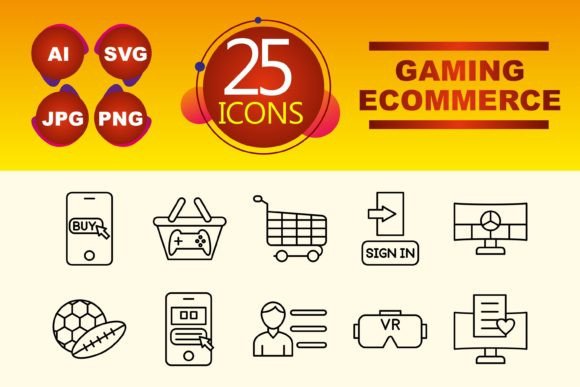
Consider your primary need: is it rapid deployment for a one-off project, or building a reusable design library for ongoing work? A set with multiple file types caters to both. However, if your project involves highly specific, branded illustrations beyond generic ecommerce functions, a more custom solution might be necessary. The ten line icons covering core Gaming Ecommerce concepts offer a foundational toolkit. They are most valuable for projects requiring clear, minimalist visual cues around shopping, purchasing, and digital delivery within the gaming context—from a mobile app's clean interface to a business website's familiar user pathways.
Ultimately, the utility of such assets lies in their ability to communicate function instantly. For the consumer, this means a smoother buying experience. For the creator, business owner, or professional, it means a more efficient way to build the environments where those experiences happen. Whether your priority is creative expression, commercial efficiency, or educational demonstration, visual coherence in Gaming Ecommerce interfaces is not just an aesthetic choice; it's a functional one that serves different stakeholders in profoundly different, yet equally vital, ways.