Visual Communication for Healthcare Commerce
The digital marketplace for healthcare is expanding at an incredible pace. Medical ecommerce encompasses everything from the sale of prescription medications and durable medical equipment to wellness products, telehealth platforms, and subscription-based health services. It's a sector where clarity, trust, and accessibility are paramount. For creators designing within this space, the challenge is to communicate complex, sensitive information with simplicity and professionalism. This is where dedicated visual assets, like a tailored set of icons, become not just decorative elements but essential tools for building intuitive user experiences.
The Role of Iconography in Medical Digital Design
In any ecommerce environment, icons guide users, denote functions, and establish visual hierarchy. In medical ecommerce, their role is amplified. They must convey concepts like "pharmacy," "consultation," "delivery," or "medical records" instantly and without ambiguity. A user looking for allergy relief shouldn't have to decipher a confusing symbol; they need to find the path to relief immediately. A well-designed icon set acts as a universal language, bridging the gap between the user's need and the platform's functionality. It reduces cognitive load, builds confidence in the service, and enhances the overall usability of a website or app.
Unlocking Creative Applications Across Formats
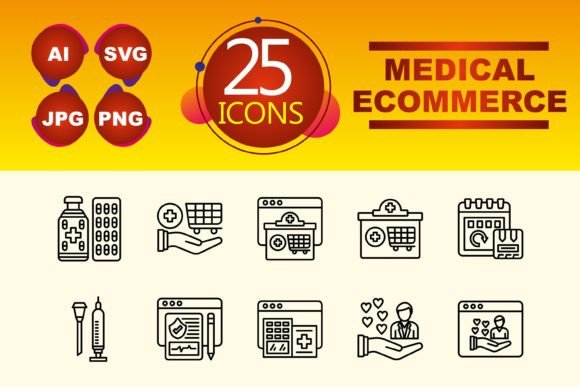
A cohesive set of medical ecommerce icons is a versatile design resource. The consistent style and thematic focus allow it to be adapted across numerous projects, creating a recognizable brand identity wherever it's applied.
- Mobile App Interfaces: Use the line icons for tab bars, feature buttons, and status indicators within a telehealth or pharmacy app. Their clean style ensures they remain clear even on smaller screens.
- Website Templates: Integrate them into product category navigation, service overview sections, or as illustrative elements next to key value propositions like "secure checkout" or "fast shipping."
- Presentation & Infographics: Elevate slides explaining a medical ecommerce business model or an infographic comparing service features. Icons transform dense data into an engaging, easy-to-follow visual story.
- Marketing Materials: Employ icons in email newsletters, social media graphics, or digital brochures to highlight specific services, such as a pill icon for medications or a heart icon for wellness products.
- User Interface Prototypes: When wireframing or prototyping a new healthcare platform, using these icons provides immediate context, helping stakeholders visualize the flow and features during early design phases.
Adapting Icons for Diverse Audiences and Goals
The beauty of a focused icon set lies in its adaptability. Different users will extract different value, tailoring the assets to their specific audience and communication goals.
A freelance designer building a website for a local pharmacy might use the icons to create a simple, trustworthy online ordering system. An entrepreneur launching a subscription vitamin service could use them in a sleek mobile app to denote subscription tiers and delivery schedules. Educators or publishers creating content about the future of healthcare might embed these icons into articles or reports to visually break down ecommerce components. Even a hobbyist or blogger discussing personal experiences with online medical services could use them to add visual clarity and professionalism to their posts.
The key is to maintain the icons' core purpose—clear communication—while adapting their placement, size, and color to suit the project's tone. A mental wellness app might use softer colors alongside the icons, while a surgical supply site might keep a more stark, professional palette.
Ensuring Effective and Consistent Implementation
To leverage these icons effectively, practical considerations are crucial. The inclusion of multiple file types—AI, JPG, PNG, SVG—is a significant advantage.
- SVG files are essential for web and app development, allowing for scalable, crisp rendering at any size without loss of quality.
- PNG files with transparency are perfect for digital graphics and presentations.
- AI files give designers full editorial control within Adobe Illustrator, enabling them to adjust colors or combine elements if needed for a unique brand identity.
Consistency is the foundation of professional design. When using the set, apply the icons uniformly. Decide on a standard size or scale relative to your text. Choose a color scheme that aligns with your brand and applies it consistently across all icons used in a single project. This creates a cohesive visual language that users will quickly learn and trust. Avoid using only a few icons in isolation; deploy the set as a whole system to represent all major facets of your medical ecommerce offering, ensuring no part of the user journey is left visually unexplained.
From Inspiration to Finished Project
Let’s consider a realistic example. Imagine you’re tasked with designing the interface for an online platform that sells home diagnostic kits—like blood pressure monitors or glucose tests. You need sections for product categories, a learning resource center, a secure checkout, and customer support.
You can map the icon set directly to these needs: a "device" icon for products, a "document" icon for resources, a "cart" icon for checkout, and a "chat" icon for support. Using the line style from the set, you create a clean, uncluttered navigation bar. You then use the same icons, perhaps slightly larger, on the corresponding landing pages to reinforce the section topic. For a promotional infographic about the benefits of home testing, you could use a sequence of icons—a "home" icon, a "device" icon, and a "doctor" icon—to visually narrate the process from self-testing to sharing results with a physician. The entire communication feels integrated and user-friendly.
The ultimate goal is to bridge the gap between the digital commerce experience and the user's healthcare needs. By employing a dedicated, clear set of medical ecommerce icons, designers and creators can build interfaces that are not only functional but also empathetic and easy to navigate. This thoughtful visual design supports the serious nature of healthcare while harnessing the convenience and accessibility of modern ecommerce, creating digital spaces where users feel informed, guided, and confident in their choices.