Understanding Law and Legislation: Symbols for the Digital Age
The concepts of law and legislation are foundational pillars of society, representing the rules, structures, and principles that govern our collective life. In our increasingly digital world, these abstract ideas often need to be communicated quickly and visually. This is where specialized icon sets, like collections of Law and Legislation icons, become incredibly valuable tools. These visual symbols bridge the gap between complex legal concepts and user-friendly design, serving as essential elements in mobile apps, website templates, presentations, and more.
The Visual Language of Justice and Order
Before diving into the practical use of these icons, it’s important to grasp what they represent. Law refers to the system of rules created and enforced through social or governmental institutions to regulate behavior. Legislation is the specific process by which a legislative body, like a parliament or congress, makes these laws through statutes or acts. Icons designed for this theme aim to encapsulate symbols associated with this domain—images like scales of justice, gavels, legal documents, statutes, caps, and shields. They act as a universal shorthand, allowing designers and developers to convey themes of authority, fairness, process, and legal compliance without lengthy textual explanations.
The Purpose and Significance of Legal Icons
Why do we need dedicated icons for law and legislation? The significance lies in communication efficiency. In user interface (UI) and user experience (UX) design, every pixel and element counts. A well-chosen icon can:
- Guide users intuitively: A document icon next to a button immediately suggests "view paperwork" or "download a form."
- Establish trust and professionalism: For a legal firm's website or a compliance app, using recognizable legal symbols reinforces the brand's domain expertise.
- Simplify complex information: In an infographic about the legislative process, icons can break down steps (drafting, debating, voting, enacting) into an easily digestible visual flow.
- Cross language barriers: Visual symbols are often more universally understood than text, making them ideal for international applications.
Their purpose transcends mere decoration; they are functional components that enhance understanding and interaction.
Exploring a Practical Icon Set: Features and Flexibility
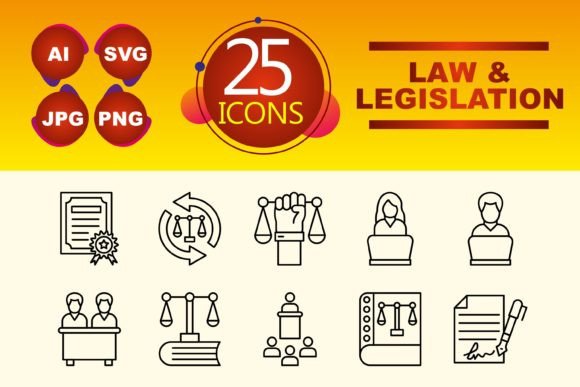
Consider a specific set that covers Law and Legislation with relative icons. A typical package, designed for maximum utility, might offer 10 core icons in a clean Line Icon style. This style, characterized by outlined shapes without filled colors, is particularly popular for its modern, minimalist look and excellent scalability. The included file types—AI, JPG, PNG, and SVG—are crucial for practical application.
Why These File Formats Matter
- AI (Adobe Illustrator): This vector source file allows designers to edit, scale, or modify the icons without loss of quality, perfect for custom branding.
- SVG (Scalable Vector Graphics): Essential for web development, SVGs are resolution-independent, ensuring icons look crisp on any screen size, from mobile phones to desktop monitors.
- PNG & JPG: These raster formats provide ready-to-use images for contexts where vectors aren't supported, like some presentation software or simple image placement.
This multi-format approach ensures the icon set fits seamlessly into any project phase, from initial design in Illustrator to final implementation in a live website's code.
Fitting Into Modern Digital Life and Work
The relevance of Law and Legislation icons spans numerous fields. They are not just for lawyers; they are for anyone communicating about rules, processes, or governance.
Applications in Technology and Business
In mobile apps, these icons might be used in platforms for legal document management, civic engagement apps that track legislation, or corporate compliance training modules. A "gavel" icon could signify a dispute resolution section, while "scales" could indicate a fairness or settings panel. For website templates, especially for legal services, government portals, non-profits, or educational sites on civics, these icons provide immediate visual cues that establish the site's purpose and credibility.
In the business world, internal systems dealing with contract management, regulatory reporting, or policy dissemination rely on clear UI. Icons here reduce cognitive load for employees, helping them navigate complex internal platforms more efficiently.
Enhancing Education and Creativity
For educators and presenters, these icons are powerful tools in slides and infographics. Explaining the branches of government, the steps of a bill becoming a law, or the structure of the judicial system becomes more engaging with visual aids. They cater to different learning styles and make information more memorable.
From a creative design perspective, a cohesive icon set provides a toolkit. Designers can maintain visual consistency across a whole project—a website, a brochure, and an app—using the same family of symbols. This unity strengthens the overall communication and brand identity.
Clarifying Common Misunderstandings
A common assumption is that such icons are only for "serious" or "dry" topics. While they are inherently professional, their clean line style can be adapted to feel approachable and modern, suitable even for apps aimed at educating young citizens. Another misunderstanding is that using icons is merely an aesthetic choice. In reality, as outlined, it's a foundational UX/UI principle that affects usability, comprehension, and accessibility.
It's also worth noting that while icons are powerful, they must be used thoughtfully. The meaning should be clear or supported by a label if the context is ambiguous. The goal is to aid understanding, not create new confusion.
Building a Broader Understanding
Integrating these icons into digital projects is more than a design task; it's about understanding how visual communication supports our comprehension of abstract systems. Law and legislation, while textual and procedural in reality, govern every aspect of daily life—from business contracts to traffic rules. By giving them visual representation, we make these pervasive concepts more tangible and navigable for the general public.
This aligns perfectly with modern SEO and content principles like E-E-A-T (Experience, Expertise, Authoritativeness, Trustworthiness) and creating Helpful Content. An article or a website that uses clear visuals to explain complex subjects demonstrates expertise and enhances user experience, making the information more authoritative and trustworthy.
Conclusion: Symbols as Bridges to Understanding
A set of Law and Legislation icons, particularly in a versatile line style with multiple file formats, is a resource that empowers clearer communication in our digital ecosystem. From the designer editing an SVG in a web app to the student viewing a PNG in a presentation, these symbols serve as bridges, translating the important, yet often intricate, world of legal and governmental processes into a visual language everyone can start to understand. They remind us that in the intersection of technology, design, and information, even the most foundational societal concepts can be made accessible, engaging, and immediately useful.